

How Many Crickets To Feed Leopard Gecko
Arguably the most pop beginner'south reptile, the leopard gecko has been available in pet stores for over 30 years as convict-bred specimens. Leopard geckos are friendly beginner reptiles, as they're docile, require piffling space for an enclosure, and are generally easy to care for.
If you lot're looking to add together a leopard gecko to your collection, we've got you covered. This article compiles all the information you'll need regarding leopard geckos and how to keep them.
Leopard Geckos (Eublepharis macularius) in the Wild
The leopard gecko's natural habitat ranges from Northeast India upwardly into the Middle E, in countries like Pakistan, Iran, Iraq, and Afghanistan. They enjoy a semi-dry climate, living in arid desert scrub and dry forests. They brand their homes on rocky structures, where they can bask on peak and hide underneath.
Their leopard-like impress is a naturally occurring design meant to function as camouflage in their natural environment and are shy lizards who like to hide from any sign of danger. When threatened, they will wag their tail methodically and drop it if necessary. Additionally, when food is abundant, they can store fatty in their tail, assuasive them to hide for long periods of time when necessary.
Because they are evasive by nature, leopard geckos tend to shed frequently in the wild too as in captivity as they attempt to hide their aroma from predators. When faced with danger, yet, leopard geckos will bark, chirp, and hiss, making themselves seem more ambitious and less highly-seasoned to predators.
Understanding leopard geckos in the wild helps keepers empathize the behaviors and habits of leopard geckos in captivity. While the majority of leopard geckos available for purchase are captive-bred, this doesn't completely remove their wild behaviors, and leopard geckos volition even so exhibit them when kept equally pets. Using the information we know about wild leopard geckos leads to more informed decision-making when keeping them in captivity.
Leopard Gecko Size and Advent
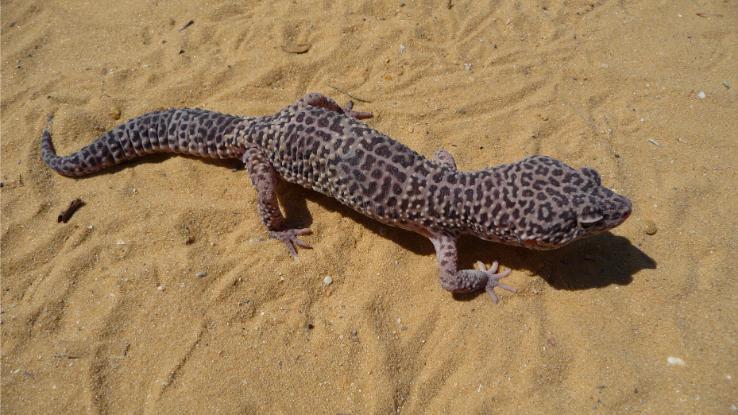
Leopard geckos are relatively small in size, with females being six to eight inches in length when full grown and males being seven to 11 inches in length. While they are geckos, they are different from the wall-crawling lizards yous may exist familiar with. Leopard geckos are terrestrial in nature, and as such, their bodies differ from that of the mutual firm gecko.
Leopard geckos have thick, triangular heads, with a articulate separation between their body and their tail. The torso is, at times, thinner than their tail is, with thin limbs sprouting from the front and rear of it. The limbs have sparse digits, unlike the mucilaginous pads you run into in business firm geckos. Leopard gecko tails tend to be thick and chunky, every bit it's where the lizard stores its fat for times of food scarcity.
Aptly named for their most common pattern, leopard geckos appear to have leopard spots all along their body. They're nearly commonly yellowish with black or brown spots, merely many other variations of colors, likewise as patterns, are available cheers to selective breeding.
These geckos that don't have their natural coloration or pattern are chosen morphs. Morphs tend to sell for more money than their natural counterparts, with some being much rarer than others.
Leopard Gecko Lifespan
The lifespan of a leopard gecko in captivity can range from 15 to 20 years. When purchasing a leopard gecko, it is a long-term commitment and should be treated equally such.
Leopard Gecko Enclosures
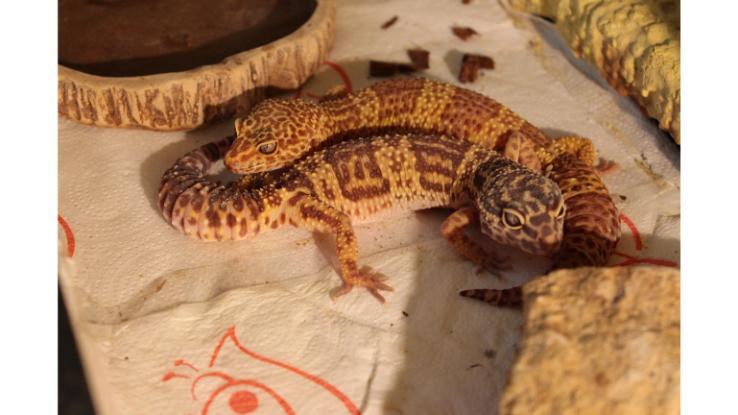
Unlike many other reptiles, leopard geckos don't need a large corporeality of infinite to be happy, and they don't need their enclosure to be smaller while they are hatchlings. One single gecko should be kept in a thirty-gallon tank.
Enclosures can exist traditional drinking glass terrariums or even opaque plastic storage bins, so long as the walls are at least 12 inches loftier. A secure screen should be kept on top of the enclosure to prevent any possible escapes.
One of the most important aspects of a leopard gecko enclosure is the decor inside of it. Leopard geckos need at least three hide boxes. 1 hide box needs to be filled with moist moss or vermiculite so that shedding can take place properly. Foliage tin can be added also, giving them semi-hidden areas to roam too.
Substrate is another important aspect for leopard geckos. Though their natural habitat consists of sandy landscapes, sand should exist avoided in leopard gecko terrariums, equally the consumption of it tin can lead to intestinal blockages. Suitable substrates include newspaper towels, aspen shavings, cypress mulch, or coconut cobweb. Leopard geckos similar to use the restroom in ane corner of their enclosure in most cases, making cleanup like shooting fish in a barrel. Paper towels will need to be changed daily, while natural beddings can exist spot cleaned as needed. In general, it is best to avoid reptile rug as their nails may get snagged and come up off.
Leopard Gecko Lighting and Heating
Equally with many other reptiles, leopard geckos are temperature sensitive, and their enclosures demand to exist fix as such. Two bulbs will exist needed; a daylight basking bulb and a ceramic heating seedling for nighttime. The heat gradient for a leopard gecko should range from 75 to 90 degrees, allowing them to roam the enclosure to regulate their temperature properly.
Leopard geckos are entirely nocturnal, meaning that they need at least 12 hours without daylight to maintain a healthy mean solar day and nighttime cycle. To finer heat their enclosure at dark, the ceramic bulb tin can exist used. However, if that'south not effective at maintaining ideal temperatures, under-tank heating can exist used instead.
Leopard Gecko Diet and Water Needs
The nutrition of a leopard gecko is beginner-friendly every bit they but eat insects their entire life. Many other reptiles are omnivorous or are vegetarian with specific dietary restrictions. Leopard geckos will consume crickets, mealworms, waxworms, Dubia roaches, and small hornworms. The rule of pollex for feeding leopard geckos is based on the historic period of the gecko, also every bit the size.
- Hatchlings up to vi months in age should be fed one insect a day.
- Juvenile geckos from half dozen to 15 months should be fed one insect every other 24-hour interval.
- Adult geckos should be fed every three days and should exist offered an insect for every inch of gecko-body length (i.eastward., a six-inch gecko gets six insects).
The insects should be gut-loaded 48 hours prior or dusted prior to feeding with a calcium and D3 vitamin supplement each time they eat. This ensures that the lizard is getting the necessary nutrition from their meals.
A water bowl should be kept in one area of the enclosure that an entire gecko can fit in only does non allow for a water level to a higher place their ears. This provides the humidity that leopard geckos need in their enclosure, besides equally a place to soak and absorb water when needed. Make sure the water dish is not under a estrus lamp.
Leopard Gecko Behavior
Leopard geckos are unlike many other reptiles as they live communally in the wild likewise as in captivity. Leopard geckos are very territorial, and if there is more than one in an enclosure, they will more than than likely fight relentlessly.
In the wild, leopard geckos spend the majority of their time climbing or burrowing, and their convict environment should provide areas to climb in the very least, though a thick layer of substrate for burrowing is preferred too.
Nearly all leopard geckos' activities volition occur at dark. This includes hunting and vocalizing. Equally such, leopard geckos need to be fed at dark and allowed to roam their tank. As such, they should about probable non be kept in bedrooms, every bit their vocalization and scurrying can get quite loud.
Leopard Gecko Handling
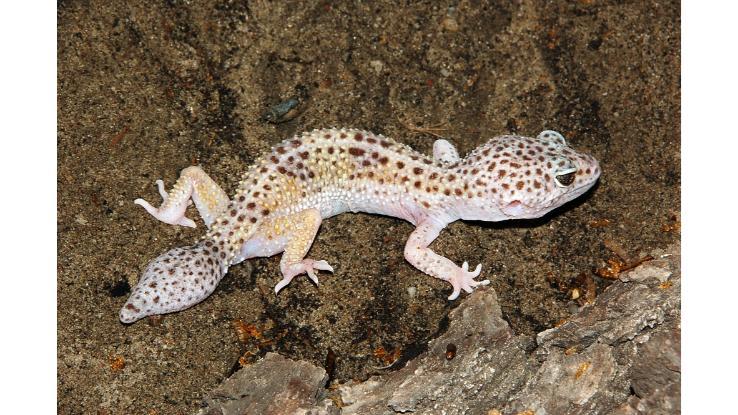
Treatment a leopard gecko can be done and can provide the reptile with a good amount of enrichment. Equally such, there are practices that need to be put into place when handling them. They are able to drop their tails if threatened, so picking upwardly a leopard gecko by their tail is something that must never be washed.
Additionally, they like to climb, then when handling them, walk them using the hand-under-manus technique. This allows for plenty of climbing and enrichment outside of the enclosure.
Leopard Geckos: The Perfect Beginner Reptile
If y'all're looking to dive into keeping reptiles, offset with a leopard gecko is a solid choice. They're hardy lizards that live for fifteen to 20 years in captivity and have very basic requirements when compared to other reptiles. Get a leopard gecko or several; you lot won't be disappointed.
SOURCES:
Leopard Gecko Care Sheet and First-Time Owners Guide | Everything Reptiles
Leopard Gecko Care Sheet | Reptiles Magazine
How Gut Loading Works | The Bandbox
Source: https://www.reference.com/pets-animals/leopard-gecko?utm_content=params%3Ao%3D740005%26ad%3DdirN%26qo%3DserpIndex&ueid=8c78a488-1864-462f-b8a5-13d374434192
0 Response to "How Many Crickets To Feed Leopard Gecko"
Post a Comment